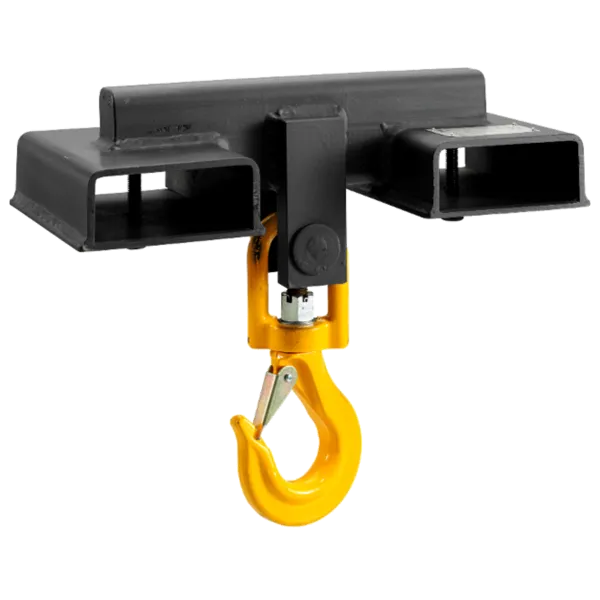
In short: A lifting hook is pushed between the forklift's forks and turns the forklift into a crane-like lifting point, letting you lift loads by a ring, chain or sling. The choice depends on the load capacity and how many items you need to lift at once. Before buying, always check the hook's load capacity and that the mount fits your forks.
What is a lifting hook for?
In warehouses and production, loads sometimes already have a ring, chain or lifting sling attached instead of a pallet. Chain reels, metal structures, motors or generators are typical examples. You can't lift these with bare forks, but a lifting hook makes the forklift well suited for the job, especially when a crane isn't readily available.
The hook is pushed onto the forks and locked in place. You then hang the load from the hook exactly as you would from a crane.
Common types of lifting hooks
- Short heavy-duty hook: designed for heavy, compact loads, attaches firmly and low between the forks.
- Swivel hook: the hook can rotate freely, which is handy when the load needs to be turned while hanging it.
- Double hook: two hooks, useful when lifting two rings at once or keeping the load balanced.
- Extended-arm hook: the hook sits further out from the forks, giving the load more room, but reducing capacity more than the short version.
What to pay attention to when choosing?
The first and most important figure is the hook's load capacity. It must exceed the weight of the load being lifted and must also take into account the forklift's own load chart, not just the marking on the hook.
- Fork dimensions: the hook's inner dimensions must match the width and thickness of your forks, otherwise it won't sit securely.
- Locking: a good hook locks onto the forks mechanically, not just by friction, so it doesn't slide off during driving or lifting.
- Centre of gravity: a load on a hook hangs further forward of the forklift, which reduces real load capacity more than the same weight on a pallet.
Common mistakes
- Judging capacity by eye: a hook may look strong, but what matters is the manufacturer's rated limit, not the visual impression.
- Wrong hook for the ring: too thick a hook won't fit a narrow ring, too thin a hook may wear out faster at the ring's edge.
- Not checking the lock: the hook appears attached, but the locking mechanism isn't fully engaged.
If you also lift goods from higher shelves, it's worth looking at our lifting cages for working at height. You'll find all forklift attachments in our lifting hook range. Tell us your forklift's make, fork dimensions and load weight, and we'll recommend the right hook. For questions, contact us via our contact page.
Tell us your machine's make and model - we'll help you find the right attachment. We are the official importer of SE Equipment in Estonia.