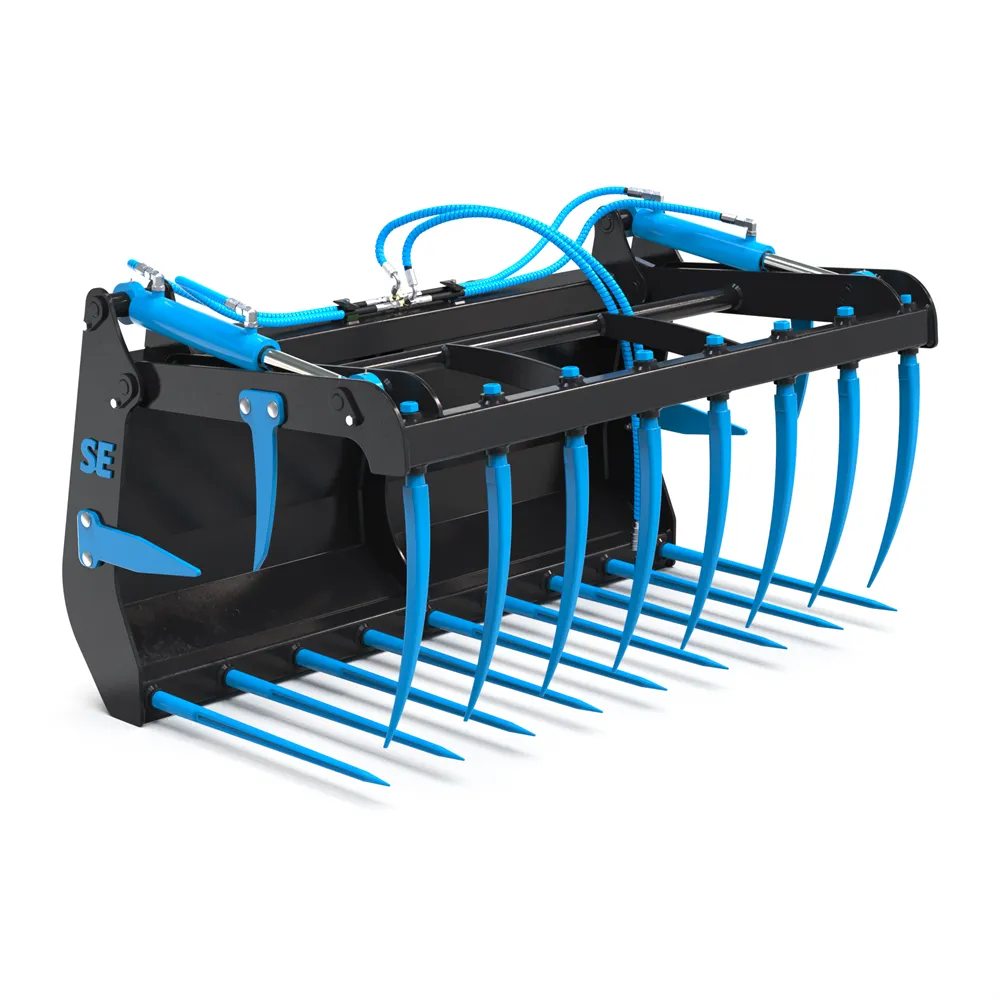
In short: The main task in silage and feed handling is keeping the material dense and intact until feeding time. A silage grab is suited to lifting and opening bales, while a silage fork is for cutting loose silage and distributing it into the feed trough.
Why a standard bucket doesn't work for silage
Silage is a compacted, fibrous material that sticks and doesn't come cleanly out of a regular bucket. On top of that, you want to preserve silage's density when handling it, so it doesn't spoil from air exposure. That's why silage and feed have their own dedicated attachments, designed to hold the material together, cut it, and distribute it precisely.
Silage grab - for lifting bales
- Use: lifting, moving and stacking round and rectangular silage bales.
- Advantage: keeps the bale's shape intact, doesn't needlessly tear the wrap and doesn't squeeze the silage too much.
- When to use: when storing bales, hauling them, and distributing feed before a bale is opened.
See the range on our silage grabs page.
Silage fork - for cutting loose silage
- Use: cutting silage from a bunker or the edge of a clamp and distributing it into the feed trough.
- Advantage: sharp tines cut through the compacted mass without needing to pry the silage face open and expose more of it to air than necessary.
- When to use: in daily feeding, when silage is in a bunker or large clamp rather than in bales.
What to keep an eye on to preserve silage quality
Every time the silage face is exposed more than necessary, the material starts spoiling at the surface. That's why it's worth choosing an attachment that lets you cut or lift exactly as much as needed and keep the rest of the mass covered. It's also worth checking the condition of the grab's and fork's tines regularly - dull tines crush and tear the material instead of cutting it, which speeds up spoilage at the edges.
Which machines these fit
Most silage grabs and silage forks are made for loader mounts, but also fit when mounted on a telehandler. If you use the same machine for feeding as for other loading tasks, it's worth choosing an attachment that can be swapped quickly on the mount for other loader attachments.
Tell us whether you work with round or clamp silage and which machine you use, and we'll recommend a suitable attachment. Get in touch via our contact page.
Tell us your machine's make and model - we'll help you find the right attachment. We are the official importer of SE Equipment in Estonia.