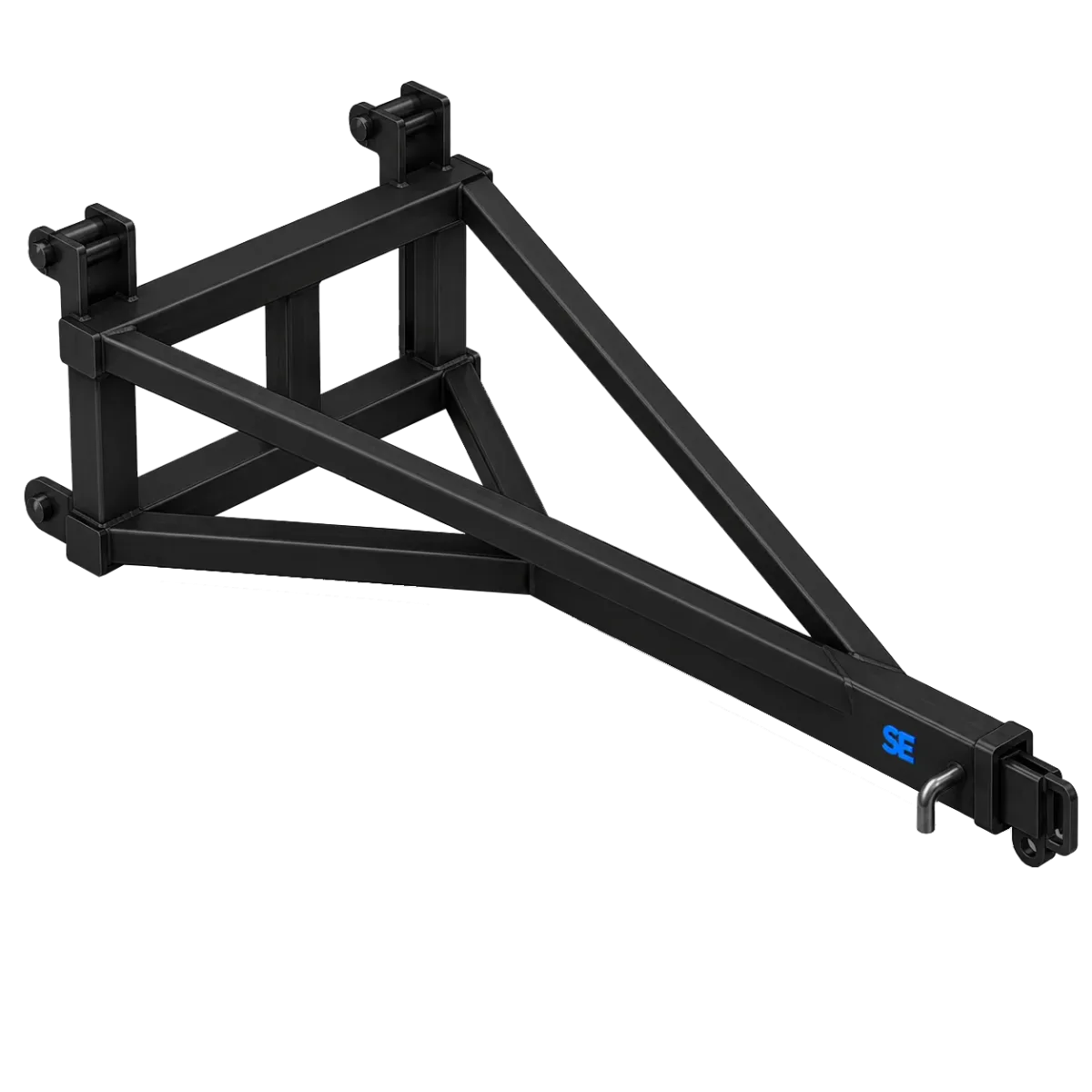
In short: A crane jib mounts on the skid steer's boom and gives the machine a crane function, for example lifting loads from a hook. A mechanical jib is simple and has a fixed length, while a hydraulic jib lets you change reach and height from the cab.
What is a crane jib and when do you need one?
A crane jib is a frame with a hook that mounts on the machine's quick-attach the same way as a bucket or forks. It lets the skid steer lift loads that are easier to handle with a hook and chains or straps than with a bucket or forks.
- Lifting installation elements: for example pipes, tanks, formwork or heavier spare parts.
- Precise, controlled lifting: lifting by hook allows more precise load control than a bucket.
- A temporary solution: no need for separate crane equipment when the lift is short-term and the machine is already on site.
See the range on our skid steer crane jib page.
Mechanical crane jib
- Simple and light: a fixed-length frame, no auxiliary hydraulics needed.
- Cheaper: fewer parts, less maintenance.
- Downside: you only change reach and height using the machine's own boom movement - the hook's position relative to the jib is fixed.
Hydraulic crane jib
- Adjustable reach: the jib can be extended or raised from the cab, giving a larger working area.
- More precise positioning: the load can be held in place while the machine stays still, which is safer for precise placement.
- Downside: needs auxiliary hydraulics on the machine and costs more than the mechanical version.
What should you pay attention to?
- Load capacity and load chart: lift force decreases the further the hook extends from the jib - this must be clearly known.
- Mount compatibility: the crane jib must match the machine's quick-attach, see our loader mounts.
- Frequency of use: for occasional lifting, mechanical is enough; for more frequent and precise work, a hydraulic jib is worth considering.
For heavy loads, such as lifting logs together with moving them, it's also worth looking at a log grapple, which suits grabbing several logs at once when the lift isn't a single-point load.
We'll help you choose
Tell us what and how often you plan to lift, and what machine and hydraulics you have. We'll recommend whether a mechanical jib is enough or a hydraulic one is the right choice. Get in touch via our contact page.
Tell us your machine's make and model - we'll help you find the right attachment. We are the official importer of SE Equipment in Estonia.