In short: Daily work in a warehouse or port is repetitive - pallets, crates and containers come in and go out. What matters most here is lifting capacity, the strength of the attachment's mount, and how quickly you can swap it for the next load.
What gets lifted daily in a warehouse or port
Most warehouse work involves moving pallets, crates and packaged goods between storage areas and trucks. In ports and larger warehouses, tipping containers are also used, for loading and unloading waste, aggregate or other bulk material.
- Pallet forks: the standard solution for lifting pallets and crates and loading them onto trucks.
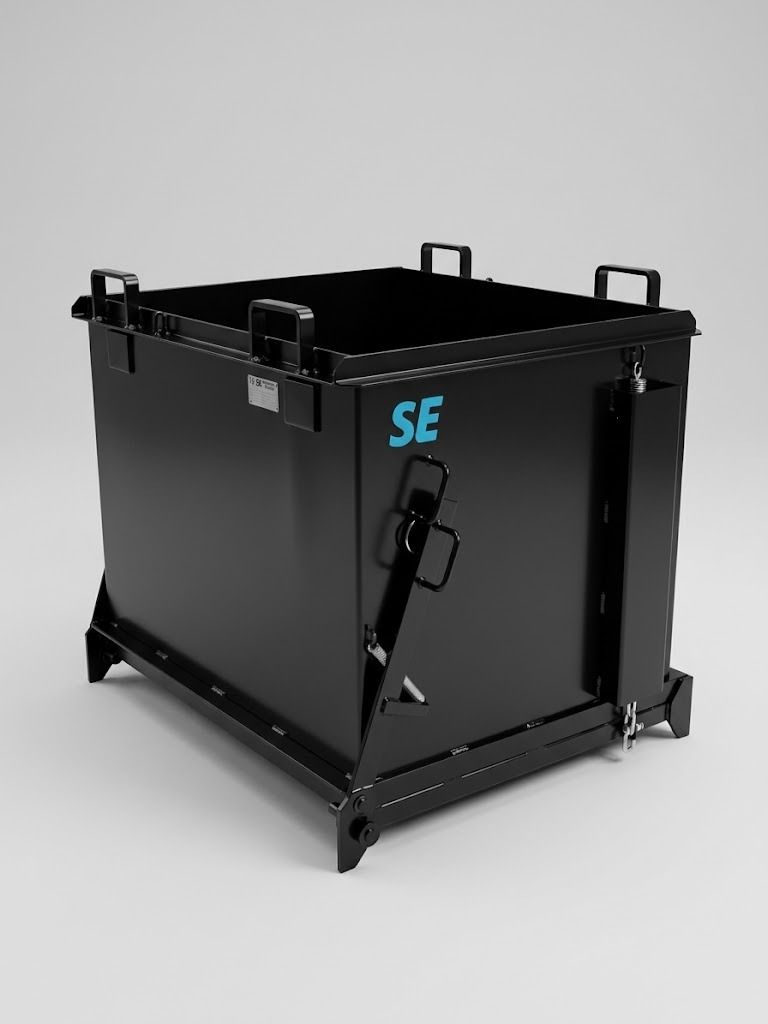
- Tipping containers: let you load material into the container and tip it empty with the same forklift, without a separate crane.
- Grapples: for holding rolls, blocks and irregularly shaped loads securely.
You can see all forklift attachments on our forklift attachments page.
What to check before ordering an attachment
Warehouse and port attachments need to carry heavy loads repeatedly and over long periods, so capacity and mount quality matter more here than elsewhere.
- Load capacity: the attachment's maximum rated load must be clearly higher than what's actually lifted - constant work at the limit wears the mount faster.
- Mount type: the forklift's mount must match the machine's quick coupler exactly, otherwise the attachment won't lock reliably.
- Swap speed: if one machine handles different tasks during the day, it's worth choosing attachments that can be swapped quickly and safely.
Uses for tipping containers
Tipping containers work well in situations where material needs to be received all at once and later emptied in a controlled amount - for example in waste handling, aggregate storage or a warehouse sorting area. They remove the need for a separate emptying device.
Safety when handling heavy loads
When working with large loads, checking the mount lock at the start of every cycle matters even more than with lighter work. Before lifting a load, make sure the attachment is locked and that the load's center of gravity stays within the forklift's stability limits. Faster work isn't worth it if it ends with the attachment falling.
Tell us what loads you move and how often, and we'll recommend an attachment with the right capacity. Get in touch via our contact page.
Tell us your machine's make and model - we'll help you find the right attachment. We are the official importer of SE Equipment in Estonia.